Posts

Showing posts with the label rocks

[News] 320-million-year-old fossils discovered at Cape Enrage, New Brunswick (Canada)

Image
by Allan April - Writer, and Laura Lyall - CTV News Atlantic Videographer Published Monday, August 10, 2020 9:55PM ADT CAPE ENRAGE, N.B. -- With its spectacular views of the Bay of Fundy, New Brunswick's Cape Enrage is a popular tourist destination. But some recent discoveries of the ancient variety have researchers exploring the area. Researchers from the New Brunswick Museum are searching for ancient signs of life along the base of the seaside cliffs of Cape Enrage, N.B. “Often we’re walking a beach, we might see something different,” explains Olivia King, a research associate with the New Brunswick Museum. “We may see a recent rock fall that happened, and at that point, we usually stop, take a minute, flip over a couple of rocks.” In doing so, the team has made a major discovery -- the first evidence of ancient animal life found at the location. Fossilized footprints of amphibians, reptiles, horseshoe crabs, giant...

Clifton, New Brunswick (July 5th, 2017)

Image
Good morning to all. I'm sure a whole lot of you are starting to feel the tug to go out, but in these strange times is proving to be difficult due to the circumstances. With being at home gave me a bit more time to work on side projects and catch up on my blog. Thus, in the spirit of being stuck home, I'll be posting a few of my past ventures and trips. Lets dial this one a few years back. Olivia In July 2017 I had gone out on a field trip in Northern New Brunswick. This is part of field on behalf of the New Brunswick Museum. I joined Matt and Olivia on field work to check the Clifton site to see how it had progressed and the state of the cliffs. If you want to find out more about Cliftion, you can search my blog site for past posts that has a lot more details on the site and the type of work going on there (ie. morphology, formations, composition, stratigraphy, etc. Matt Clifton is amazing when it comes to the specimens that come out of that place. ...

'First Animals' - A New Documentary On Early Life From CBC's "The Nature of Things"

Image
CBC's The Nature of Things is airing its documentary 'First Animals', a look into early life Friday, October 25th, 2019 at 9 PM on CBC-TV. - First Animals episode description on CBC's website. Here are links to several of their blog posts: Meet the weird, wacky and wonderful creatures that lived in Cambrian seas over 500 million years ago - by Graham Duggan High in Canada’s Rocky Mountains, the animals of an ancient ecosystem can be seen battling for life. The fossils of the Burgess Shale offer a glimpse at the incredible diversity of early life on Earth, frozen in time and locked in stone — you just have to go digging to see it. ( Click here for more... ) The ROM quarry site high up in the Rocky Mountains. Paleontologist scales the Rocky Mountains to uncover Earth’s very first animals - by Jean-Bernard Caron, Richard M. Ivey Curator of Invertebrate Palaeontology at the Royal Ontario Museum It’s 6:53 a.m. on Aug. 19, 2019. My body is primed to wake up — ...

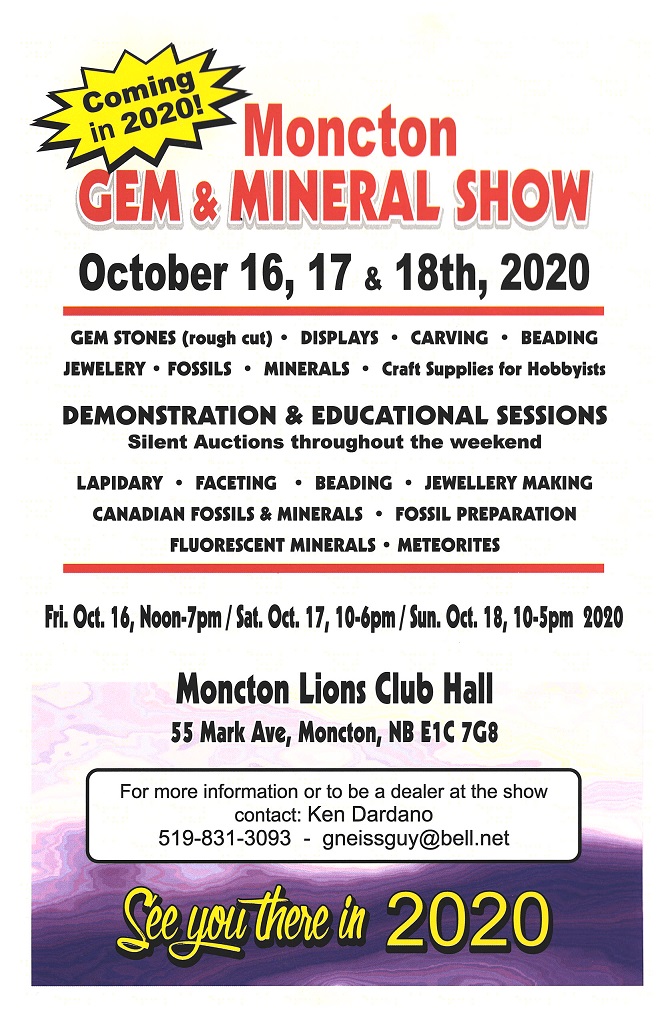
Save The Date! Moncton's First Gem & Mineral Show in 2020!

Image

Rock Hunting in Rockport (May 7th 2011)

Image
One site I've been going to since I started rock hunting is Rockport, located between Dorchester and Sackville, New Brunswick. The more I go the more interesting things I find. Slacks Cove is full of places you can stumble upon cool rocks, fossils, or dead animals such as a half eaten seal.. burk! Reaching Dorchester the road splits between 106 (towards Sackville) and the 935 towards Dorchester Cape. I take the 935 south and drive a few minutes until the paved road turns into a dirt road. A few hundred meters from where the road changed I stop my car and park it on the side of the road where the old road cuts into a new one the government constructed last year. I've stopped a few times but didn't had the chance to check these red cliffs. I've spotted some fossil plants but very sparse. There's also a lot of big boulder-size conglomerate rocks all over the place, standing out amidst the red silt. What I had to cross to get to the beach. The tide a...

[News] 'Millennium Falcon' fossil shows what it took to thrive 500 million years ago

Image
by Emily Chung Cambroraster was similar in some ways to lampreys, stingrays and horseshoe crabs. When paleontologists first spotted the large spaceship-like fossils in B.C.'s Kootenay National Park, "we really didn't know what to make of it," recalls Joseph Moysiuk, part of the excavation team. (Andrew Gregg/Red Trillium Films) A new fossil species named after an iconic starship is both unlike anything that exists today and uncannily similar to many modern animals, from stingrays to horseshoe crabs. When paleontologists first spotted the large, round shield-like fossils in B.C.'s Kootenay National Park, "we really didn't know what to make of it," recalls Joseph Moysiuk, part of the excavation team. "We nicknamed it 'The spaceship'... because we thought it looked a lot like the Millennium Falcon," he added, referring to Han Solo's iconic ship in the Star Wars series. It became more than a nickname — the creature's fo...

[News] Possible Nova Scotian United Nations geopark a hidden gem

Image
[Personal note: The UNESCO team has been on site these past few days and I'm sure they're amazed by what they've seen. You can visit the Cliffs of Fundy Aspiring Global Geopark facebook page -- https://www.facebook.com/fundygeopark/ -- to get updates. Let's hope that they'll join the Canadian Geopark family¹!] from The Chronicle Herald - published June 25th Evaluators from UNESCO will be in Cumberland and Colchester counties in late July to evaluate the proposed Cliffs of Fundy Aspiring Geopark as a potential UNESCO Global Geopark. - Tourism Nova Scotia Maybe we should turn left at Truro once in a while. Many, if not most, Haligonians escaping the city on a summer road trip just sail through the hub city on their way north to P.E.I., New Brunswick or central Canada, or east to answer Cape Breton’s siren call. There are highway signs, though, that tease the knowing traveller west, to places like the beguili...

[News] N.L. (Newfoundland) fossils star in Oxford University exhibit documenting Earth's earliest animal life

Image
by Chris O'Neill-Yates · CBC News · Posted: Jul 22, 2019 Fossils from Mistaken Point and Bonavista give researchers unparalleled look at origins of life. Jack Matthews, a research fellow at the University of Oxford's Museum of Natural History, stands next to a display showcasing fossils that document the story of the beginning of animal life on earth. (Chris O'Neill-Yates/CBC) Jack Matthews, a research fellow at the University of Oxford, strides across the lawn in front of the Museum of Natural History at Oxford University with a broad smile on his face. His excitement about fossils — which have become his life's work — is contagious. The Latin names of ancient life-forms preserved in rock drop effortlessly from his tongue as he climbs the stairs in the imposing three-storey neo-Gothic building to Animals First, an exhibition tracing the origins of animal life on earth. "It's like tracing your family tree back to your very earliest ancestors,...

I'm back (hiatus and activity)

Image
Hello and welcome back. I've been on hiatus for quite a bit. I've been active, but not as much as I would let myself be. Dealing with things, such as mental health can take a turn and put a stop on things, such as my passion for rocks. This past while it's been an uphill trek to get back, but I'm getting back to form. One way to deal and heal is to partake in what you're passionate about, and for me its of course rocks. I have been active for a bit, but didn't find the motivation and/or energy to get back online, but this is a form of therapy that is dearly needed. The next bit I'll be posting my past travels, field work, and new things such as paleo news. Why not stay current with old things right? I've recently made some new discoveries that I'll share in future posts. Here's a preview: Stay tuned! - Keenan

Dorchester Cape (July 5th, 2018)

Image
On July 5th I went for a drive down Beaumont, in the Memramcook region in South-Eastern New Brunswick (Canada), to check how bad the road along the coast had eroded with time since the last time I went down there rock picking. I stopped in a few places to check on the rocks down the beach wherever I could go down, and spotted the cliffs of Dorchester Cape across the Memramcook river. Hopped in the car and proceeded to make the short few kilometers trek to the other side. Location indicator shows Dorchester Cape on the map (Google Maps) Location of the cliffs The geology of the area is mostly formed of Upper Carboniferous rocks, and the location I was at is mostly Boss Point formation. The Boss Point formation is also found in Cape Enrage, Rockport, and Upper Joggins, to name a few places. The fossils that I find at the Dorchester Cape site is mostly discombobulate plant material, with dark grey to tan sandstones with some sandy conglomerate boulders lying about. Chunks of gypsu...